
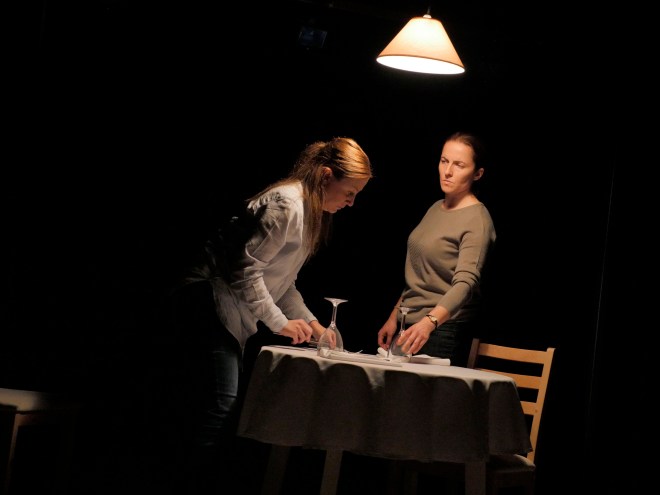

Today is World Mental Health Awareness Day and it made me think about the two characters in Rattle Snake. Coercive controlling behaviour in domestic abuse impacts on their ability to think, feel and to escape. They are both trapped, not only by the perpetrator but by the state. Tactics are used to annihilate, reduce to nothing and no-one is in their corner.
JEN:
In the first couple of months we were happy, he was good with the girls
But then, I was having a bad day. I suffer with depression
James came home from work, the house was a mess and the dog wouldn’t stop barking
He’s particular about the work surfaces, they need to be wiped clean, I know that, its just his thing, if its not wiped clean, if there’s a stain, no matter how small, he can’t relax
He starts to clean the work surface, then the cooker, he empties and repacks the fridge, mops and polishes the floors. He scrubs the whole house and doesn’t stop till its 12 o’clock. He puts the lead on the dog, slams the door and is gone for two hours. He comes home and goes straight to bed
The next morning I make his breakfast, bait and say ‘I’m sorry’
I make sure I clean the house top to bottom every day. I know its not fair on him, I feel ashamed that I’ve let the house go, I feel bad I’ve upset him
I’m walking on eggshells
Mental ill health can be a result of domestic violence, and it can also be used against victims/survivors, to threaten and control….later in the play there is a family court scene and the perpetrator tells the judge ‘she’s mad’ and ‘unstable’ and ‘shouts at the kids’. How the state views mental health, the stigma and discrimination his weapon.
I’ve been asked to write an article about Rattle Snake and two of the prompts are ‘Why are the issues worth tackling?’ and ‘Why is theatre useful in tackling these issues?’
I met a young man/boy in a referral unit yesterday. He watched the play, and then asked to speak with me afterwards. With his teacher present, he told me about how his real dad had been like the man in the play, how his dad, like the man in the play, had moved on to other women, had more children and how his mother and the other women are now free. However, though he is safe, he is also triggered when the ‘real father’ tries to get in touch with him. I am especially proud of the children’s voices in the play, they are being heard and they need to be, as we know their mental health is also being affected and they are also in need of services and support.
When writing this blog I wondered how to end it, why am I writing it, other than knowing it was World Mental Health Day and that had made me think about the play and the two characters, but also the real life women I’d interviewed to make the piece. Then I returned to the prompts. Why are these issues worth tackling? Answer: because domestic violence/abuse affects us all – this isn’t a play about others, these issues are present in each and every one of our lives; we know someone in this situation (or have been).
Coercive control is present in the majority of domestic abuse cases, and the presence of coercive control means there is a higher risk of death (two women are killed every week), not only of the victim/survivor but the children. A recent study ’19 Child homicides’ found that in all cases the perpetrator had access to his children, with 12 families having access granted by the family court. It matters because we find ourselves in 2017 living in a world where others feel a sense of entitlement to take away another person liberty, to control, threaten and annihilate.
The second prompt is about ‘Why is theatre useful in tackling these issues’. The theatre Open Clasp make holds the voices of the women who put their trust in us. We take this theatre to diverse audiences, access the arts to those others find hard to reach as well as mainstream theatres. We have a huge responsibility to make the best theatre we can to ensure the biggest impact, and Rattle Snake is doing just that – theatre is unique, its live, playing out in front of you – audiences are left breathless, valued, empowered and angry and I like that.
Catrina McHugh MBE
Image of Jen & Suzy by Keith Pattinson
