
Date posted September 16, 2025 Posted by Carly McConnell Reading Time 4 Minute(s)
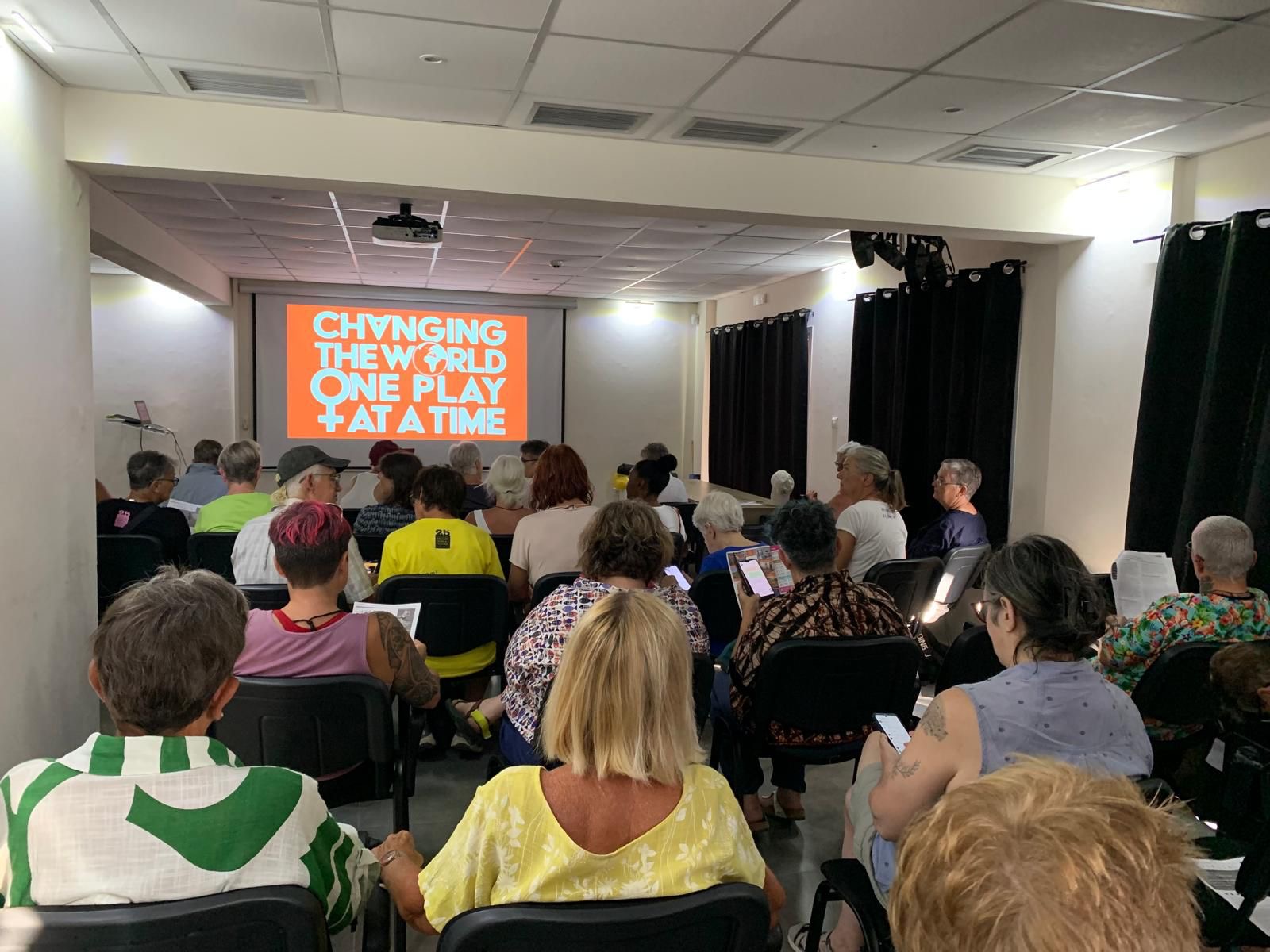
Late last week Mycelial was screened in Greece as part of the Sappho Women’s Festival. After the screening a panel discussion took place and as part of the discussion our CEO Catrina McHugh read out a letter which she had been sent by Anna, a sex worker and staff member of Red Umbrella Athens. Anna’s letter was emotional and raw, describing their lived experience of being a sex worker in Greece. Below you can read Anna’s letter.
Sisters, friends and allies,
I have spent 40 years in this job, and I’ve realized there is no real will to change the system. The law governing sex work in our country was written in the 18th century and focuses only on public health. But sex work today is very different, and this outdated law actually supports and fuels sex trafficking because it can’t realistically be enforced. It ends up harming workers while encouraging illegal activity.
One of the rules in this law is that I must be unmarried. No other profession has this kind of requirement, you’re either a sex worker or you’re married.
This makes me feel like a second-class citizen. I have my license, but I also have to find a place to work. If I want to work in an apartment building, it must have a separate entrance, and every owner must agree, which is practically impossible. So, it must be a detached house. Another rule requires that the house be at least 200 meters away from schools, churches, parks, tutoring centers, dance schools, or any place where people gather, even senior citizen centers. Today, there are around 400 brothels in Athens, and all of them are technically illegal. How could they be legal when the rules make compliance impossible? It is outrageous that the government maintains this system of illegality while pretending it is lawful.
In 1999, the law changed the term from “women who sell sex” to “people who sell sex.” As a trans woman, I saw this as a small victory, a sign that we were being slowly accepted by society, at least a little. But after many years, I realized this so-called “privilege” simply reinforced stereotypes about trans people.
What kind of job do most people imagine a trans woman has? What’s the first thing that comes to mind? Be honest, if you immediately think of Syngrou Street, a well-known area for sex work, you’re not alone. If you didn’t think of it, maybe you’re lying to yourself or just don’t care. That’s how powerful stigma is.
How many of you have ever been served by a trans employee in a public or private place? In a store? A restaurant? Isn’t it strange that a whole group of people has been forced to live like this for so long, always in the shadows, visible but unseen, associated only with sex work, disrespect, and violence?
The world would be better if trans people could study freely and work in jobs they enjoy and excel at. Maybe not now, but someday it could be different, and it would be better. No one should have the right to tell you what you are, how you feel, or what you do, especially if you’re not harming anyone. If some trans people choose to work in sex work, that is their right, just like anyone else has the right to work where they want. That is one thing. But it is completely different when you want to live the life you dream of, and society does not allow you to. I believe that sex work, when done by choice, can even be one of the highest forms of feminism. Let the TERFs and SWERFs dream of prisons if they want to, we dream of freedom.
Over the years, activism became a duty for me, a way to lend a hand to those who are less strong. In these movements, trans sex workers are among the most excluded. That’s why, in 2015, I was invited by Positive Voice (the Greek Association of people living with HIV) to bring the Red Umbrella movement to Greece. This global movement fights for sex workers’ rights and against stigma. Women and trans women in sex work are easy targets for theft, abuse, disrespect, rape, and even murder, sometimes at the hands of citizens, sometimes politicians. Most victims of serial killers are sex workers. It is absurd that when we are abused and report it we are the ones accused. And if this happens even to women with “normal” lives and jobs, who are often blamed or even murdered for reporting abuse, how much hope do we have for better treatment? But I still hope. I hope for myself and for every woman like me.
With the Red Umbrella Athens team, psychologists, lawyers, social workers, sex workers, and many volunteers, we began a public conversation about these issues. We made the problems visible and encouraged society and politicians to adopt the term “sex work,” leaving behind shameful words like “prostitute” or “whore.” Our main demand remains to change the outdated law I mentioned earlier.
Because sex work is work. It carries responsibilities, yes, but it also deserves basic rights.
Thank you for listening, for caring and for fighting alongside us.
Anna
Red Umbrella Athens
Board member of the European Sex Workers rights Alliance
