
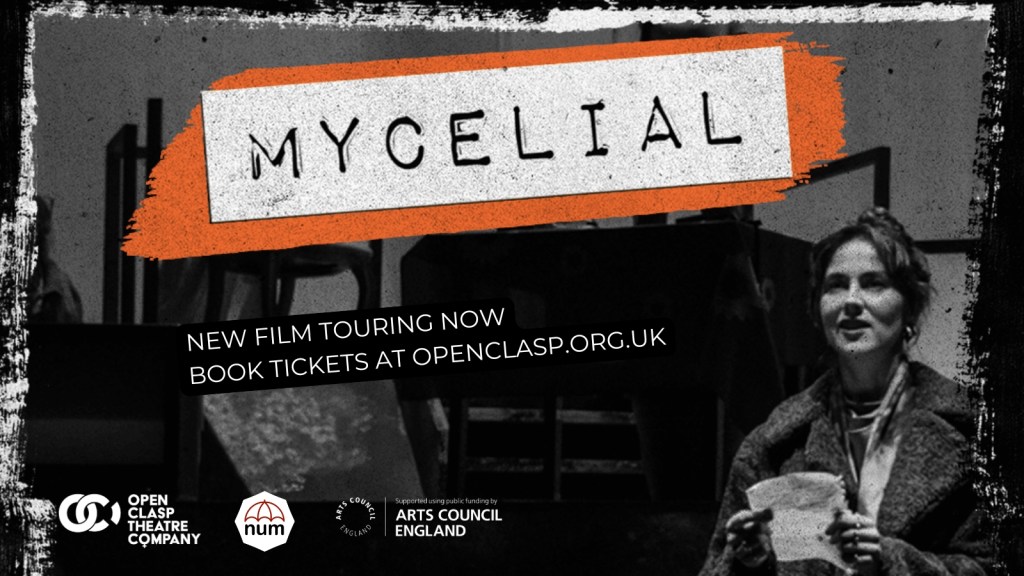

I’m talking to Carly and Ellie, our Senior Creative Producer and joint CEO. Both have been on the tour of Mycelial. We are half way through a national and international tour. A production co-created with sex worker activists. It took four years in the making, stumbled and stood tall during the pandemic and here it is, doing what was asked. Theatre creating space for discussion and debate, Open Clasp the scaffolding and sex workers front and centre stage.
We have visited Derry (North of Ireland), Leeds and Durham (north of England), Belfast and Stockton. I’ve been unable to attend the screenings due to some health issues and I was keen to hear how it was going.
If you had to pick a standout moment so far, what would it be?
Ellie The panel discussion in Belfast, with a very warm and engaged audience, gave context to the “whorearchy” and a long struggle to address the danger caused by the ‘Criminalisation of the purchase of Sex’ or ‘Nordic’ model since 2015. This panel was able to talk to successes and progress in Belfast towards decrim. Danielle Roberts, from Reclaim the Agenda, had written policy which had been adopted by members of Unison to support decriminalisation & recognising sex work as work. You could feel the audience ignite to action, pledging to be allies & challenge where needed.
Carly: In Belfast, Mardi the co-ordinator from Sex Workers Alliance Ireland talked about being a sex work activist for decades and how exhausting it is to be the same activists all the time trying to make change happen. The feedback from the Belfast audience was one of real support, saying they will be at the next gathering for the International Day to End Violence Against Sex Workers (17th December) as allies.
You are both from Belfast. How did it feel taking the company and introducing us to Belfast? How did it feel being in a country with the Nordic Model as law. What was the audience response?
Ellie I always have the people I love and know at the shows – I’m so proud of the work. In Belfast it was my family, extended and ‘known me since I was wee’! They had heard me talk of Mycelial, of the process, of the stories within and the panels – they had asked lots of questions mostly what the word ‘Mycelial’ meant and sort of got it. But, the theatre cut through all that chat & they didn’t ask so many questions at the end. They were full of knowledge, provocation and fizzing! I watched the power of this work, of theatre, to move the conversation on.
Carly: The work we co-create really does stand up to ‘that sh*t’s global!’. It felt right to be in Belfast, to introduce our work and methodology of co-creating accompanied by experts on the panel, as I feel it’s an activist city. One audience member who regularly attends marches and political arts events, (trans-rights, LGBTQ+, anti-racist) said they looked around the room and saw new faces, faces they recognised and family – the space created with our partners was a safe one bringing established and new allies together with sex workers and sex work activists.
Mycelial was launched in Derry as part of Foyle Pride, what were you expectations versus the reality?
Ellie: It was great to be programmed for Foyle Pride, it was just before the Northern Ireland Assembly published their new framework to end violence against women & girls, following the stats of 2023: 4000 sexual violence incidents and 23 women killed (since our screening this has risen to 25, making Northern Ireland the most dangerous place on continent for women). Sex worker activists are asking for sex workers to be included in that framework. On the night of our screening a woman was murdered in the city, they held a vigil a few days later on the steps of the Guild Hall, residents asking for their politicians/the assembly to do more. We asked the same; for the NI Assembly to watch Mycelial and join the conversation.
Carly: Our panel in Derry talked about the real, acute danger and horrendous violence sex workers face daily and how the current laws in Ireland do not help but reduce the protection of sex workers.
Leeds was the next venue after Derry. My understanding is you had a cinema/queer audience, new to the company, can you describe their feedback on the show?
Carly I do remember feedback saying as a regular cinema goer to Hyde Park Picture House that they would love more films to be programmed like Mycelial. The idea of theatre for film may put people off because it’s not a concept that most audiences have experienced, but I loved how up for it the audience in Leeds were!
“Really appreciated the breadth of experiences included, and attention paid to intersectionality. The voices of the people included felt real, genuine and not overly edited.”
“All the struggles are interlinked and that isn’t always made explicit. You hardly ever see things in the public sphere created or co-created by sex workers. It’s important and should be made more accessible!”

Durham and Gala Theatre – you had two screenings of Mycelial, was there a difference in response for the screening or discussion?
Carly: In the afternoon, we had women from Aspire, Chester-le-Street who have worked with Open Clasp for decades. Their response was one of thoughtfulness, reflection on how they could have supported sex workers in the past within their local community but didn’t know the resources there, and the connections made to National Ugly Mugs who can provide information and resources to the group. The audience as a whole was an older one, women who have been active in their communities across Durham for decades, who were just coming to understand the lives of sex workers and found the film eye-opening. Many stayed behind afterwards to talk to our panellists and staff about what they can do on a local policy level. It felt hopeful, women who have been out on the front line in communities recognising where they also need to be an ally.
The evening audience were our networks and sex work activists. We were joined by Durham County Council Staff, academics and students from Durham University and arts audiences.
How did it feel thinking back to the venue where Key Change was performed for film, Lasagna hosted and now with Rupture will be showcased there in Spring 2024 – How is this venue a good space for Open Clasp?
Carly Gala is a really important venue for us, it is the hub where we can gather our strong networks of women, artists, academics, students and front line workers together to discuss the change needed and the ‘how’ to make it happen.
Panels – what do they bring to the screening/event? What is the additional power of a panel as they are made up. How are they different from other panels you have attended. What is the most powerful moment in the panel discussions?
Carly At the end of the film, the audiences are hungry for more; more context, more information on the law and what they can do. Having experts, sex work activists and co-creators on the panel allows for audiences to really understand more, to hear the call to action and take away with them ideas. Even if that is to call out rhetoric the next time they hear it. When I’ve been chairing and looking out over the audience as the panellists speak, you can physically see them leaning forward, wanting to know more. Many people are coming to the laws and lives of sex work for the very first time. The panels support the film in raising awareness.
The screening arrived in Stockton as the town found itself at the centre of debate around sex work laws. Media coverage on Teesside was centred on protests, where “peaceful” demonstrators held up signs saying “say no to prostitution” and “prostitution free zone”. Can you share your reflections on this, art and life moment?
Carly Every conversation around sex work must also involve sex workers themselves, speaking about what they require to feel safe and have their rights and needs understood and met. There is wider debate needed around how laws are impacting sex workers and communities. The panel raise concerns of the “Nordic Model” which exists in Northern Ireland and sees the buyer criminalised, rather than the sex worker, as this model places more power in the hands of the buyer, forces sex work underground and has sex workers vulnerable to potential attacks and even murder.
Some people think legalisation is a better model – such as in Amsterdam. But, the fact you require a permit can create its own barriers for people who may then work in more unsafe conditions.

Do the audiences in England feel different from Ireland?
Ellie Every audience has felt different! And as this is theatre for screen, that has felt different too. In Belfast, our ‘cinema’ audience clapped along with the filmed ‘theatre’ audience, from a year ago. In this digital format we meet our aim of ensuring ownership in a location. The audiences and local experts and cocreators on panels bring relevance and context and focus action. It is so exciting to be halfway and look ahead to New Zealand screenings and online availability for the #16 days.
Carly: I think in Ireland there may be a bit more of a difference in awareness of laws as since the Nordic Model was brought in the North, it’s been in the regional media more. In England, very few people know what the laws in England are, where the current government sit around the Nordic Model or that decriminalisation is even an option. They leave the cinema/venue with much more knowledge than they had before.
Tell me one thing you have learnt
Ellie I’ve learnt and seen how Mycelial has created a scaffolding for sex work activists to use as they build their movement. That the movement will always show up and that all of us can be better allies firstly by creating safe spaces for sex workers to claim their rights (btw in Ireland there is training for venues).
Carly: There are allies who hear and want to do what they can. There is hope at the end of the events, a call to action and a sense of allyship that feels real.
One thing you will take away from the tour so far
Ellie For audience members who are not engaged or who are a little – Mycelial tour will move you towards supporting decriminalisation and give you the tools to educate others and challenge discrimination.
Carly: When talking about workers rights, violence against women, the violence towards the LGBTQI+ community, include sex workers. Sex workers really are ‘f***ing everywhere’.
I return to the tour this week, visiting HMP Askham Grange, HMP Low Newton and HOME in Manchester. The week after we are in Dublin and Cork. We head down to London for the 29th October and Mycelial flys to Aotearoa/New Zealand, as well as screenings here for the NESWF. The tour concludes at our home, here at West End Women & Girls Centre on the 10th and 11th of December. Moving online from the 25th Nov to 17th Dec.
To date we have reached approx. 300 audience members. Here is some of their feedback..
“Excellent production, how it was filmed and presented. I learned a lot. Came into it a loose / distant ally but now I feel more compelled to be more active.” Audience Member (aged 45-54) in Belfast
“Importance of solidarity. Storytelling is power. Intersectional feminism is a must. ‘Mycelial’ beautifully captured how these networks of incredible people survive.” Audience Member (aged 35-44) in Belfast
“Really informative and moving piece. It has inspired me to be better in my allyship & ask my workplace (working with young people who are homeless). To get training and show up to the marches this year.” Audience Member (aged 35-44) in Belfast
“I really enjoyed the performance and discussion. Whilst I knew a bit about sex work in England, it was very helpful to learn about its diversity, intersectionality and impact on a global level. I learned a lot and felt that the performance and discussion explained a lot (such as terms) with such clarity.” Audience Member (aged 45-54) in Durham
“I loved the variety of voices included in the performance. All the struggles are interlinked and that isn’t always made explicit. You hardly ever see things in the public sphere created or co-created by sex workers. It’s important and should be made more accessible!” Audience member (aged 18-24) in Leeds
Catrina McHugh
