
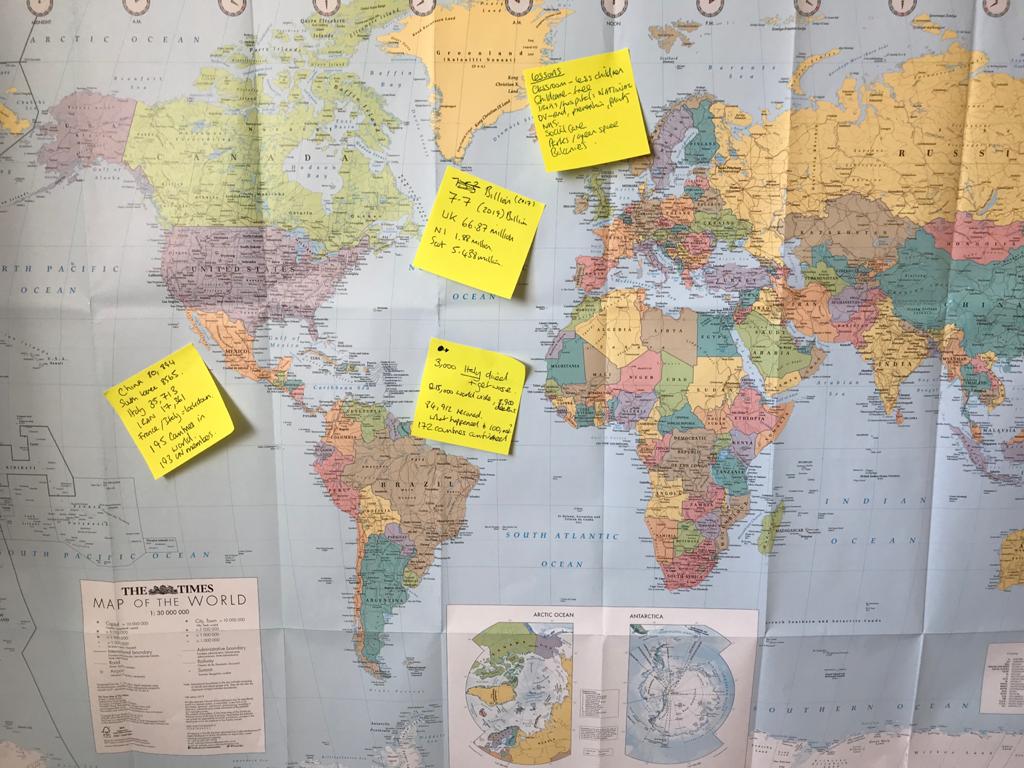

I’m writing this blog in a moment in time when there is a global pandemic. When it began, and we had all unplugged computers, found wires, mics and set up Skype so we could work from home, I put up a map of the world and started counting countries and people.
I was interested in the maths: the 7.7 billion people, 66.87 million in the four countries of England, Wales, Ireland and Scotland. When they said affecting 172 countries, I wondered how many countries there were and found 195, with 193 as UN members. At that time, I wrote notes on post-its, we were at 215,000 people affected worldwide, with 8,900 deaths and 84,912 recovered. I noted countries and numbers. Today as I write we have 2,503,456 coronavirus cases worldwide, with 171,810 deaths and 659,536 recovered. I started to wake and look at stats and graphs, take my temperature, start to cry, get angry and drink too much. I’ve had moments of denial, danced with the wife, invited friends over for dinner only to become awake again and realise it’s not over yet. I’ve cried at the distance with our son, his sister and her baby and my chosen family. My heart has felt for my colleagues, teams with their families far and out of reach and I’ve raged at the lack of ability to manage a pandemic. Hearing that in 2016 a pandemic, to see how we would cope, and we didn’t. We didn’t learn or put in place what is needed – that we can’t test, test, test because we were too late.
I had started the year with a sense of foreboding. I didn’t tell the wife, no-one. I thought I was depressed, as it was in the pit of my stomach, this feeling something bad was going to happen, to me. I kept thinking I was going to die, not last the year out, but had no idea where it was coming from. Then I got a bad eye infection, cellulitis. I’d gone to the walk in centre in January, thinking I needed some drops, and then she said ‘you need to watch the red, that it doesn’t circle all around your eye as you could go blind, it’s serious’. A month later it came back, the consultant said I was rundown, that I would need to think about my lifestyle, of slowing down, changing things, stop going so fast. I went to get my bloods tested, to check if there were any other underlying health issues.
It was around then that I told the wife about the sense of foreboding. But before I told her I googled it, as I’d heard about this somewhere before but couldn’t put my finger on it, and there is was. If you have a sense of foreboding it’s taken seriously by health professionals, as sometimes people have this just before something life-threatening happens. I thought then it was my eye, but now I realise it’s a bit bigger than that; it’s a pandemic and the threat this causes to all our lives. This might sound odd, and the wife said not to tell anyone about the sense of foreboding. I know it’s not me, well I hope it’s not, but it’s a weird one. As I type today, the numbers are rising, and my phone receives a text message saying another member of my chosen family is ill. Yesterday the paramedics came for one, today they took the other to the hospital, two cities and communities feeling frightened and in need of hope, light at the end of the tunnel.
When we first went into lockdown my aim was to write about a group of amazing people I was working with at the time. I wanted to write about them, but the pandemic has taken my head away, it still sits most days at front of my head and like a knot in my throat. I needed to get it out of the way which is why I’ve written the above. But they are linked.
I was leading on five sessions with a group of people recovering from addiction to either drink or drugs, or both at the Oaktrees Recovery Project in North Shields (managed by Changing Lives). Whilst in lockdown I’ve typed up the sessions, taken photos of the storyboard, scenes and characters created. I loved working with the group as they reminded me of workshops with women in prison, as like them, they thrive in group work, with the trust and momentum built, they’re not afraid to look at life, the past, present, hopes and dreams. But it wasn’t only that.
The principles of The Twelve Steps and Twelve Traditions of Alcoholics Anonymous have echoes and parallels that I can relate to when using drama techniques to create a safe space for discussion, debate and reflection. When we conclude projects, we, like the Recovery Project, look at the steps needed to achieve a future that is positive, not only for the individual but for their community and society.
Part of the Twelve Steps program is to accept a Higher Power, in print this is God, but in the sessions the group create humanity, connection and community, this is the higher power. Over the four weeks (the fifth being cancelled due to coronavirus) the group mimic lived experiences, of turning points, moments of regret, shame as well as guilt. The workshops are balanced, making space to celebrate their honesty, courage, strength, skills, talent and resilience. The process is democratic, they agree on answers to questions, placing their lived experience as 3D images/tableaus up on stage for us all to view, observe, discuss and debate. It’s through this process that change happens – you witness individuals seeing themselves and the journey travelled. They can stop time, examine, rewind and investigate the dramatic moment created. And we played, laughed and took risks.
“Brought a lot back to me but feel it was very positive. Best session – great team work and great leveller”
“The session allowed me to explore how I actually got to rock bottom – powerful reflection”
The way people in recovery stay sober is they connect, reach out and talk. They value community and humanity. As we locked down, the project worker turned to me and said how worried she was for the isolation to come. Little did we/they know the superpower that was to come.
I only spent four sessions with this group, and my knowledge limited, I’m not in recovery. I wanted to invite Angie Watters to join this blog (Project Worker with Oaktrees Recovery Project) to give an insight into how people in recovery are coping with the lockdown.
I asked Angie to talk us through what happened next for those in the recovery group when the lockdown happened.
The grant we received to do the drama workshops with Catrina had been a huge surprise. I had forgotten I’d applied, as it was almost a year to the day when it came through the post! We began the sessions in early March and I couldn’t have imagined what would emerge, it was absolutely brilliant. The courage, commitment, willingness and sheer emotion that came pouring through clients was breath-taking. To see people become so vulnerable and authentic in what they were taking part in was beyond anything we had hoped we could do.
Trying to describe recovery in any shape or form, never mind drama, to those who have no understanding or experience of it is no mean feat, but everyone seems to have their idea or opinion of addiction. There is a stigma and a lot of myths surrounding addiction, with many describing it as a “lifestyle choice”. I know and understand from lived experience and working as an addictions counsellor, that addiction is not a “lifestyle choice”. Recovery on the other hand is.
Recovery is based on making the decision to change, to decide to no longer use substances or drink alcohol. It is changing thought processes, behaviours and perspectives, taking responsibility for past actions and behaviours. To be brave and honest, to let down barriers and share openly with others around feelings and emotions, but most importantly it is about connection. That is how recovery works.
Addiction is the opposite. It is isolation, filled with shame and guilt, fear and anxiety, along with feelings of dread, desperation and an absence of hope. This, I worried, was what those in Oaktrees were going to face again with the roaring approach of Covid 19 and lockdown. ISOLATION!
What happened next was the complete opposite of what I had been predicting. People in Oaktrees have earned their places through blood sweat and tears, through sadness, pain and lost dreams (we sometimes say that this is part of the entry fee into Oaktrees). But every one of them has a length of steel running through them. When lockdown came, they quickly realised they are part of something much bigger than what happens in treatment or the recovery community in Newcastle. They remembered they were part of a massive community, with millions of members all over the globe!
Within days this community had mobilised itself. Social media was on fire, filled with information advertising women’s meetings, men’s meetings, a 2-day marathon meeting over the Easter holidays. WhatsApp groups sharing details of how to access the international fellowships of AA (Alcoholics Anonymous) and NA (Narcotics Anonymous) were spreading all over Facebook and the impact was phenomenal. Clients were reporting attending meetings in Cyprus, San Francisco, Hollywood, Wales, as well as their home towns. The superpower that is recovery was reaching out to people across the world.
There were IT gurus on tap for those of us struggling with the maze of new technology (including forgetting to turn cameras on and off!). One client disclosed being in an online zoom meeting, in the comfort of her own home thinking she had joined with audio settings, when someone asked “are you enjoying that cornetto?”.
The Oaktrees team did our best to reassure clients we would continue to support them and have put together a virtual treatment centre using the “Teams” app. We are delivering workshops, group therapies, counselling sessions and recovery check-ups by phone. I have witnessed first-hand how resilient, brave and positive clients are at Oaktrees – as Catrina stated they should be applauded for their courage, empathy and faith in each other. It is amazing what can be achieved when the common goal is CONNECTION.
What happens next? I honestly don’t know. The people of the world have been placed in a situation never seen before in my lifetime. What I do know is that the recovery community have something unique that I hear over and over again: “I am so grateful I am in recovery and have the support and love of others no matter where I am”. 12 step recovery can teach us all a lot about humanity.
Thank you, Angie
As well as this group I was also working with a group of women from Pause Barnardo’s who have lost multiple children to the care system. It was three sessions with two groups. As with the above, the women pulled on their lived experiences to create a character. Every group lead on the process, deciding on direction and issues to be explored.
The first group looked at hard places, moments with dark clouds and pain. The second, said they didn’t want to go there, they wanted to look forward to the future, find and celebrate the positives and not look back. The sessions filled with play and song, with moments of reflection, acknowledging and celebrating their grief and resilience. They found the positives to the hardest moment, like what they did on the birthdays of their children, some lost in miscarriage too. We saw them walk in the hills, stop and stare at a deer, sing, play guitar, piano and connect with each other, in the hardest moments, picking up the phone and talking.
I invited both groups to Live Theatre to see the premier of Sugar, and they were so appreciative.
In the (unbeknownst to me) final week with the group in Recovery we ended the session looking at emotion, them saying it’s like Jumanji, your emotions are there sitting in a box on the table, you can hear the throb and beat but you daren’t take the lid off. They shared their relationship with emotion, as a child having it battered out of you and/or learning that you needed to suppress tears, shut them down and how that emotion is frightening still. I love moments in workshops like this, when we find the heart of the story they are telling, when they unearth something that lets light in and moves us all forward.
“Addiction isn’t about alcohol and drugs – it’s the absence of self. This absence is described as the hole in your soul – you can’t love others when you are empty inside – recovery peels back the painful layers and heals that hold through connection, honesty and hard work”. (Voice & Recovery Project)
I am always inspired by the groups we work with, but I believe there is something different about people in recovery. You hear how hard they have worked to be where they are today, you see their rock bottom – glimpse the moments through the still images created, of them drinking when driving, with their children or so drunk that they can’t hold the bowels. I understood that sometimes they were the victim but in others the aggressor, that they have made the worst decisions possible due to their addiction. They push themselves and each other to go to those places but it’s not about guilt or shame, it’s about being accountable and moving forward to a new horizon. It’s also an ask ‘Don’t judge me by my past but see the strength within’ (title of a scene created during the project).
I felt inspired working with people in recovery and I believe the world could learn so much from their ability to reflect, learn and unlearn. They reach out to each other, hold hands, their arms wrap around, hold and support. They value community and hold on to their belief in humanity, and this should be applauded.
Catrina McHugh MBE is the Artistic Director and Joint CEO of Open Clasp Theatre Company. She is also the award-winning playwright for the company. Open Clasp make truthful, risk-taking and award-winning theatre informed by the lived experiences of women disenfranchised in theatre and society, those from minority communities and women affected by the criminal justice system.
Angie Watters is the Oaktrees Recovery Project North Sheilds Counsellor. The project is run by Changing Lives. If you need support, please click here.
